


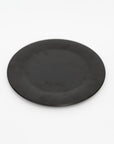
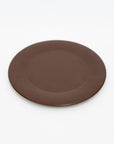
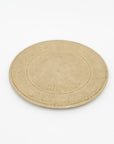
Daikokuya : Plate L 10" - Akihiko Sugita
$280.00
Description:
'Urushi' a.k.a. Japanese Wood Lacquer Japanese lacquerware is crafted using urushi, a natural sap harvested from the lacquer tree. Layered by hand and cured slowly, each coat forms a durable, smooth surface with a warm, organic depth.
Lightweight yet remarkably resilient, lacquerware has been used in Japan for centuries for both everyday tableware and treasured ceremonial objects. Its beauty is found in the balance of material, technique, and time, each piece reflecting a depth of craftsmanship shaped to endure.
Measurements:
⌀10.24 in x .55 in H
History:
Born in 1978 in Tokyo, and currently based in Kanazawa, Akihiko Sugita learned traditional lacquerware making techniques while training under Akito Akagi, a lacquer artisan who specializes in a distinct style known as 'Wajima-nuri. Sugita's works stand out thanks to their refined forms, as well as a rich luster unique to lacquer, known as 'urushi in Japanese. Over time, the appearance of each piece changes with use, as the hidden layers of urushi are uncovered. In a search for beauty within utility, his pieces subtly reveal a profound spiritual essence hidden beneath their surfaces.
'Urushi' a.k.a. Japanese Wood Lacquer Japanese lacquerware is crafted using urushi, a natural sap harvested from the lacquer tree. Layered by hand and cured slowly, each coat forms a durable, smooth surface with a warm, organic depth.
Lightweight yet remarkably resilient, lacquerware has been used in Japan for centuries for both everyday tableware and treasured ceremonial objects. Its beauty is found in the balance of material, technique, and time, each piece reflecting a depth of craftsmanship shaped to endure.
Measurements:
⌀10.24 in x .55 in H
History:
Born in 1978 in Tokyo, and currently based in Kanazawa, Akihiko Sugita learned traditional lacquerware making techniques while training under Akito Akagi, a lacquer artisan who specializes in a distinct style known as 'Wajima-nuri. Sugita's works stand out thanks to their refined forms, as well as a rich luster unique to lacquer, known as 'urushi in Japanese. Over time, the appearance of each piece changes with use, as the hidden layers of urushi are uncovered. In a search for beauty within utility, his pieces subtly reveal a profound spiritual essence hidden beneath their surfaces.
Materials:
Natural wood (Zelkova)
Natural lacquer (Urushi)
Care Instructions:
Dust carefully with soft cloth.
Variation:
Urushi lacquerware carries variation as part of its nature, not as a flaw. Because urushi is harvested, refined, and applied by hand, no two surfaces ever settle in exactly the same way. Humidity, temperature, and time all influence how the lacquer cures, creating subtle differences in tone, depth, and sheen from piece to piece.
Tiny irregularities—soft ripples, faint brush marks, slight variations in color—often remain visible beneath the polished surface. These traces reflect the movement of the artisan’s hand and the living quality of the material itself. Over time, urushi continues to mature, gently deepening in color and luster, so a piece may change almost imperceptibly as it is used.
Rather than aiming for uniform perfection, urushi lacquerware embraces nuance. Its variations and quiet imperfections give each object a distinct presence, shaped by process, environment, and touch.
Natural wood (Zelkova)
Natural lacquer (Urushi)
Care Instructions:
Dust carefully with soft cloth.
Variation:
Urushi lacquerware carries variation as part of its nature, not as a flaw. Because urushi is harvested, refined, and applied by hand, no two surfaces ever settle in exactly the same way. Humidity, temperature, and time all influence how the lacquer cures, creating subtle differences in tone, depth, and sheen from piece to piece.
Tiny irregularities—soft ripples, faint brush marks, slight variations in color—often remain visible beneath the polished surface. These traces reflect the movement of the artisan’s hand and the living quality of the material itself. Over time, urushi continues to mature, gently deepening in color and luster, so a piece may change almost imperceptibly as it is used.
Rather than aiming for uniform perfection, urushi lacquerware embraces nuance. Its variations and quiet imperfections give each object a distinct presence, shaped by process, environment, and touch.
Lacquer pieces are final sale.